
How to Prevent Condensation in Steel Buildings
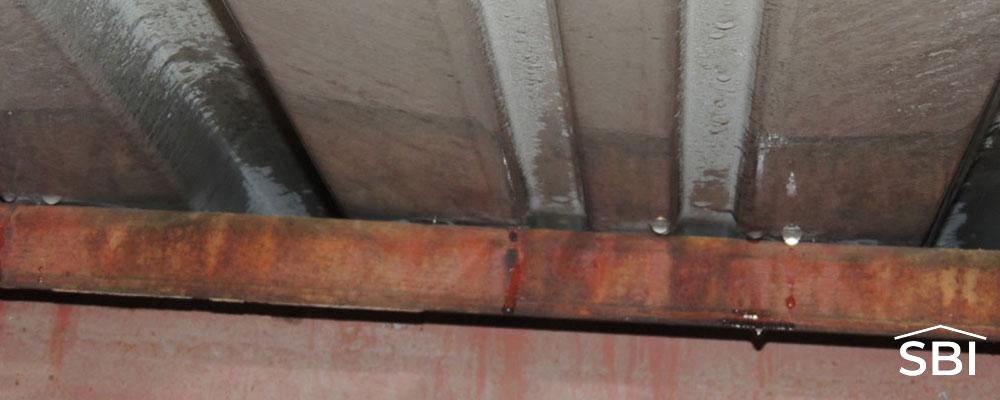
Condensation is a process in which water vapor changes to liquid. The higher the relative humidity the greater the water vapor content. Maintaining a reasonable inside relative humidity of less than 60% is an important factor in preventing condensation. Relative humidity is a percentage measurement of the amount of water vapor present in the air in relation to the amount it is capable of holding at that temperature. Warm air holds much more moisture than cold air, thus condensation is created from warm air. The indoor relative humidity can be lowered by bringing in outside air that mixes with the inside air. The temperature at which the air is saturated and can no longer hold the moisture is called dew point. When dew point is reached, the air can no longer hold in moisture causing excess moisture to be released in the form of condensation.
Condensation occurs at cold surface areas. Cold transfers through metal that is exposed to outside temperatures and forms on the warm air side. An example of this is a water glass with ice. The outside of the glass can become wet as the condensation forms on the warm air side. Visible condensation can be controlled by reducing the cold surface areas.
Heat Movement
Heat always moves towards a cooler area. There are (3) different ways that heat is transferred; conduction, convection, and radiation.
CONDUCTION is a directheat exchange through an object like steel panels, studs, or steel purlins. It can be slowed down with proper insulation such as fiberglass. CONVECTION is the transfer of heat through the air. Heat loss can be prevented by sealing all leaks and holes where air can move. RADIATION is the movement of heat in open areas. Examples of this are, the sun heating the earth or a wood stove radiating heat from the steel into the open air. Radiation heat loss can be reduced by using a reflective barrier.
Ventilation
Letting outside air into your building and letting warm moist air escape, is critical and an effective solution that minimizes condensation. This is easy to implement in attics or roofs with airspace above the insulation systems with ridge vents or end wall louvers.
In cases where a metal building is insulated from the underside of the existing roof deck there is very little if no area to ventilate above the insulation. In these cases, the insulation blankets should come in contact with the outside panel, filling the cavity and not leaving any room for airspace. The area below the insulation can be ventilated by mixing outside air with inside moist air. There are several indoor variables that put out an extremely high content of moisture, making ventilation crucial such as job site space heaters or livestock. In horse facilities, each horse perspirates approximately (2) gallons of moisture into the air each day. This does not include the moisture in the air from urine or other factors. Without ventilation or air exchanges, moisture will collect on the roof and create a moist environment which can lead to respiratory ailments and fungal growth. A good barn building design has enough ventilation to ensure six to eight air changes per hour.
Although ventilation helps minimize condensation, it is not always enough. It is necessary to have a facing or vapor retarder on the insulation. In addition, care should be taken to seal the vapor retarder which helps prevent air leaks or to keep warm moist air from reaching the colder structural components. Proper sealing of air barriers, side laps, end laps, windows, doors, and foundation sills is critical to the facing or vapor barrier performance. Moisture laden air can also transfer through joints, tears and penetrations such as lights or piping.
Concealed Condensation
Concealed condensation is one of the most difficult and damaging types of condensation. Typically, concealed condensation occurs on the underside of the steel roof deck when the roof insulation is not in contact with the roof panel, causing trapped warm air to come in contact with the outer panel.
When we see concealed condensation we often find that the facing or vapor retarder is not sealed properly for the moisture levels and the ventilation is not adequate in the building.
Condensation in Existing Buildings
Condensation in existing metal buildings happens because there is no insulation, not enough insulation, or the existing fiberglass or facing is old and torn creating air leaks. Fortunately, there are ways to help prevent or reduce any of these problems. With high energy costs there is a growing trend to seal air leaks as well as add insulation to existing metal buildings. This is referred to as an insulation retrofit. Retrofitting insulation between purlins or wall girts not only saves on energy bills, but it also addresses any existing condensation issues.
Typically, structural members (roof purlins or wall girts) are 8″ deep. It is recommended in retro fit jobs that the entire 8″ cavity is filled with insulation to avoid creating an air space between the roof panel and insulation. This is important because air spaces can cause condensation to frequently form on the inside of the cold surface of the exterior panel.
In most cases, metal building insulation was installed upon construction between the roof or wall panels and steel roof purlins or steel wall girts. This type of install causes there to be a substantial heat loss at the area where the insulation blankets were compressed between the purlins and wall girts. The positive factors with this type of install is that the vapor barrier is continuous, and the compressed insulation gives some thermal break between the outside panels and structural members. This thermal break is important in an insulation retro fit to help avoid condensation in the inside where the structural members are exposed. Adding faced fiberglass blankets to fill the entire cavity, in addition to the existing thermal break will help prevent any further condensation from forming against the exterior panels or the exposed steel members.
Condensation issues are more difficult to address in cases where there is no insulation previously installed between the outside panels and structural members. This is because there is no thermal break between structural members and the outside panels making it easy for cold to transfer from one metal to another, eventually making it into the building. Once the cavities between the purlins are filled with faced fiberglass and heat is introduced into the building, condensation or frost can still form at the bottom of the structural members. To help avoid this, a thermal break tape or strips of rigid board insulation can be installed at the bottom of the purlin or girt.
Recommendations for New Buildings
Long Term cost of ownership should be the governing element in determining a new building’s insulation needs. For any climate controlled building, we recommend a good quality vapor retarder facing as well as an insulation thickness that gives you the lowest cost of ownership. Local codes may govern the insulation minimums that are required. It is important that these codes are verified by the owner or contractor prior to making an insulation order.
Metal building insulation offers several different options. Care should be taken to seal the vapor retarder facings and or provide a continuous covering such as polypropylene to help prevent the passage of vapor into the fiberglass blankets. A continuous vapor barrier will help prevent moisture from working its way into the fiberglass. It is also important to provide a thermal break at each roof purlin or wall girt to prevent heat or cold transfer. Thermal breaks are achieved by either laying insulation over the top of the girts and or purlins before the panels are screwed down; with 1/4″ Thermal Break Tape; or with 1/2″ or 1″ Thermal Blocks.
In most cases constructors of new metal buildings compress up to 6″ R-19 faced blankets between the girts and/or purlins and the exterior panels. Any insulation over 6″ used in this method can cause the roof and walls to bow, creating waves. The insulation over the top of the red iron acts as a thermal break, however, it does not provide a high R-Value because it is limited to 6″ insulation.
Metal building roof purlins and wall girts are typically 8″ deep. Filling the entire 8″ cavity equals an R-25 system. This is often overlooked by building professionals such as architects who specify R-32 up to R-36 systems. They neglect to mention to the building supplier that the 8″ purlin depth does not meet the required 10″ R-32 or 12″ R-36 fiberglass thickness. An installer may compress R-32 10″ system into an 8″ space to meet requirements, which in turn only gives the owner at best an R-25 performance.
Double layer, high R-Value systems work well to prevent condensation. Pre-cut fiberglass blankets are factory cut to fit between the roof purlins. These fiberglass blankets are held up by steel banding fastened to the bottom of the roof purlins prior to the installation of the roof panels. The pre-cut fiberglass blankets or rolls are laid between the purlins as the roof panels are installed. These blankets come with a “long tab” which is an extension of the polypropylene facing and is around 10″ to 12″ long. The tab is placed over the purlin prior to the placement of the top layer of insulation and the roof panel installation. Overlapping the tabs creates a continuous seal for the facing or vapor retarder. With out this you will have a break in the facing at each purlin which allows warm air or moisture to work up through the insulation edges. We have seen condensation occur on the bottom side of the roof panel when the facings were not sealed. Once this insulation is installed, unfaced fiberglass blankets are laid over the top of the purlins and girts before the exterior panels are installed. This gives a high R-Value, a continuous vapor barrier, and a thermal break.
It is the owner’s responsibility to insure that the ventilation and the mechanical requirements are designed to address any condensation issues. The supplier and or manufacturer of the facings or fiberglass blankets are not responsible or liable for condensation related issues.